
Teaching Riders to Think, Not Just Do
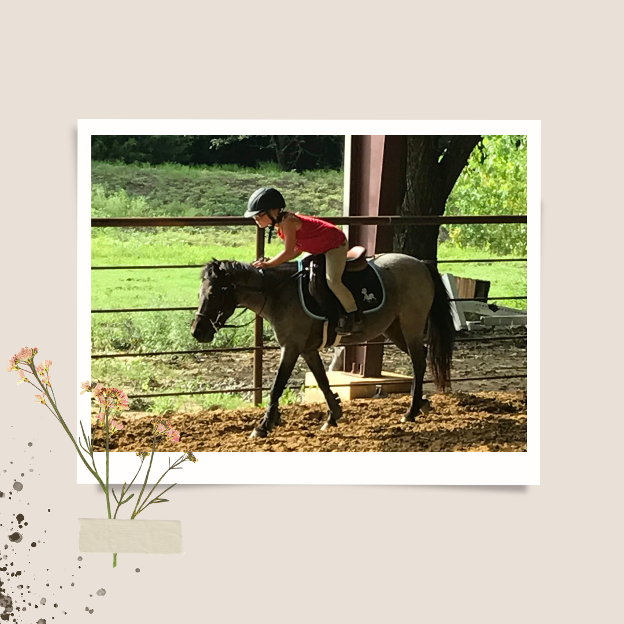
Lily and Tinkerbell
Have You Ever Wondered What Happens When the Trainer Isn't There?
Here's a question I've been turning over for a while, and I'd love for you to sit with it for a minute, too. If you've ever watched your child's lesson from the rail, you've probably heard some version of "sit back, shorten your reins, heels down, more leg" about a hundred times, and you've probably watched your child do exactly what they were told. It looks like progress, and in a lot of ways it is. What I keep wondering, though, is what happens on the day nobody's standing in the middle of the arena calling it out.
I think about this because of Susan. When my horse Wally bowed a tendon, she could have managed his rehab for me, and it would've been a lot easier on me if she had, even though his healing would have taken the same amount of time either way. Instead, she and my vet made me part of it. I was there for every ultrasound and every follow-up, and the two of them guided me through the entire process of his healing, so I learned what I was feeling for in that leg, why each step of his care mattered, and what to do when something changed. I've thought about that kind of teaching more times than I can count.
What Does That Look Like in the Saddle?
Let's say your rider keeps missing their distances to the fences, which happens to every rider who's ever jumped anything. I could tell them to move up or wait, and that'd probably get us through today's lesson. Here's what I keep asking myself, though: would they know what to do next week, at a show, with me nowhere in sight?
What I want is for them to understand why the distances aren't working, whether it's the pace, their balance, the track they're taking to the fence, or a horse who's uncomfortable, and to know which fix fits the horse underneath them. A rider who only knows "move up" will keep moving up, even on the day the real problem is a horse who's sore and telling them so as clearly as he can. Have you ever stopped to think about how many of the answers we give kids work only as long as we're there to give them?
Why Do So Many of Us Teach This Way?
I don't think there's anything careless about it. Most riding instructors start teaching because it's the natural next step after years of doing the thing they love most, and they bring every one of those years into the arena with them. What very few of us were ever given is training in how people learn, so most of us teach the way we were taught, which is exactly how most of us parent: we tell kids what to do, they do it, and it works right up until we're not there.
Here's a question for you, and I mean it gently: when was the last time you solved a problem for your child that they could have worked out with a little more time and a good question? It's the easiest habit in the world to fall into, for parents and trainers alike, and I'll be the first to admit I fall into it all the time with my own 16-year-old daughter. I'm forever reminding her and telling her what to do when I could be letting her figure it out with a few guardrails in place, and my husband is very good at pointing that out, so I'm working on it right along with you. My years in the classroom, and my graduate work in educational psychology, are what finally gave me the words for a different way of doing it.
The Space Just Past What They Can Do Alone
One of those words came from Lev Vygotsky, a psychologist who studied how children learn. He called it the zone of proximal development, which is a big name for a simple idea: the space just past what a child can do on their own, where they can succeed with the right support. Too far below that space and they're bored and going through the motions; too far above it and they're overwhelmed and scared, which is never a safe place to be on a horse. Somewhere in between is where they grow.
The support we give in that space is called scaffolding, a term from researchers who built on Vygotsky's work, and I love the picture it paints. Scaffolding goes up around a building while it's being built, and it comes down a piece at a time once the walls can stand on their own. Nobody leaves it up forever, and nobody pulls it all down on the first day. Every level in the riding program I've built works that way, handing a rider a little more of the thinking at each step until the rider is the one making the decisions.
I wonder sometimes what our scaffolding looks like at home. Which pieces are we still holding up out of habit, and which ones is our child ready to have taken down?
For the Adult Riders Reading This
If you're an adult learning to ride or working toward the next level, that zone applies to you, too, although it looks a little different than it does for a child. Most adults understand the why long before their bodies can act on it, so the work lives in getting hands, legs, and nerves to catch up with what the head already knows.
You also bring years of life experience that tell you exactly what could go wrong, and that awareness deserves respect, even on the days it shrinks your zone because you're tired, stressed, or a little scared. For an adult, the scaffolding often looks like more explanation, more repetition, and permission to stay at a height until it feels boring, which is a perfectly good place to move up from.
I've also noticed that adults rarely tell me when they're struggling; more often, they cancel a lesson or two and quietly hope it passes. If that sounds like you, please feel free to say so out loud, since your instructor can only build the right support when they know where you need it.
What Does It Sound Like?
In a lesson, scaffolding usually sounds like a question instead of an answer. When a rider comes back from a fence that didn't go well, I'll ask what they felt before the jump, what happened to the pace in the last few strides, and what they think they could try next time, and then I'll let them try it. Sometimes the fix works and sometimes it doesn't, and both are fine, since either way they're learning to connect what they feel with what the horse does.
A newer rider needs me to walk them through every one of those questions, a more experienced rider usually needs only one, and a rider who's nearly ready to move up will often come out of the ring and tell me what went wrong before I've said a word. That's my favorite moment in teaching, since it means a piece of the scaffolding just came down, and I have a feeling a lot of parents would recognize that moment from home, too.
What Could This Look Like for Your Family?
This is the part I most want you to think about. A kid who learns to stop and ask why their horse is rushing is learning to stop and ask why a math problem isn't working, why a friendship went sideways, or why a plan fell apart, and then to try a fix and see what changes. That's problem solving, and I can't think of anything more valuable to send with a child into school, a first job, and every relationship they'll ever have. A horse happens to be the most patient, honest teacher I know for it, since he gives feedback on every decision and never once pretends to be impressed.
What if, on the drive home, you traded "Did you have fun?" for "What did you figure out today?" or "What would you try differently next time?" What if you let them sit in the hard part a little longer before stepping in, at the barn and at home? You'd still be helping, with the help arriving as a question first. Please feel free to try it for a week and tell me what you notice, since I'd love to hear how your rider answers.
Eventually, I Won't Be Standing There
My goal has never been for my students to need me every time they swing a leg over a horse. I want them to notice what's happening, figure out why, and make good decisions for themselves and for their horses, and I'd love for that habit to follow them into every part of their lives long after they've outgrown my arena.
Eventually I won't be standing there. The horse will, and so will everything else life hands them.
Now I'm curious: what's one thing an instructor taught you (or your child) that stuck long after the lesson ended? Instructors, I'd love to hear yours too.
Andrea Hale
Program Manager, Aubrey Meadows Equestrian Center
Author of Hard Truths, Soft Hands